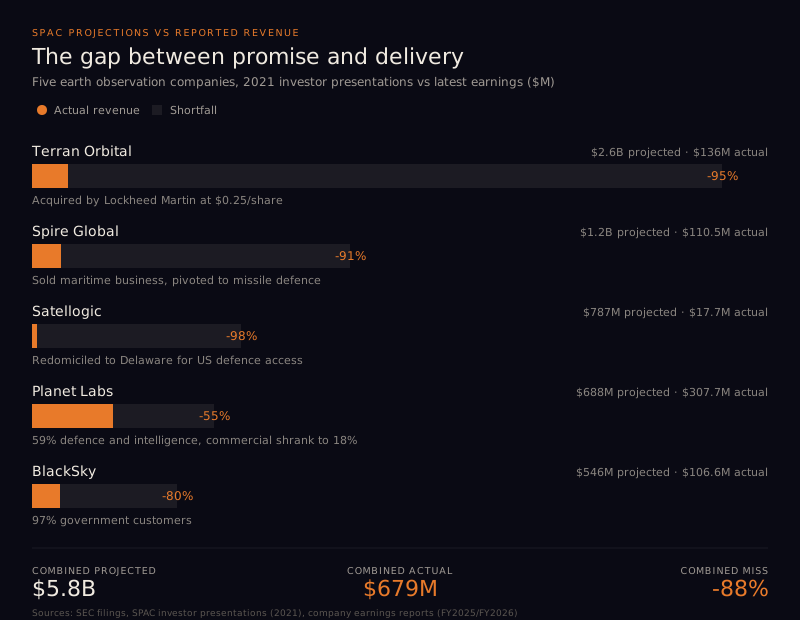
Between 2021 and 2022, five Earth Observation companies went public, promising investors that commercial enterprises would become their largest customers. Agriculture companies would pay for crop monitoring. Insurers would pay for climate risk data. Corporations would pay for environmental, social, and governance (ESG) verification. The combined revenue projections exceeded $5.7 billion by 2025.
The combined actual revenue came in under $680 million. And most of it came from the military.
These projections weren’t irrational when they were made. In 2021, interest rates were near zero, the EU Green Deal was accelerating, ESG investment was at an all-time high, and the Corporate Sustainability Reporting Directive (CSRD) was about to mandate sustainability reporting for 50,000 European companies. The world that those SPAC (special purpose acquisition company) investor decks described was the world that existed at the time. What nobody priced was the possibility that the world would change.
I spent years building climate adaptation products at an EO company. The technology worked. Insurers were buying. And the defence roadmap still ate the product, because the hardware economics of running a satellite constellation don’t wait for slow commercial markets to form. The company had found commercial product-market fit, and it still wasn’t enough. When I looked at the rest of the industry, the same pattern was everywhere.
The projections and what they assumed
Satellogic projected $787 million in revenue by 2025, from a 300-satellite constellation remapping the planet daily. Actual: $17.7 million. The company redomiciled to Delaware to access US defence contracts.
Planet Labs projected accelerating revenue growth through fiscal 2026, with its SPAC presentation forecasting that commercial customers would grow from 54% to 68% of the revenue mix. Actual revenue was $307.7 million. Commercial didn’t grow to 68%. It shrank to 18%. Defence and intelligence grew to 59% and delivered the profitability milestone that made the stock jump 23%.
BlackSky projected $546 million in revenue for 2025. Actual: $106.6 million, with 97% from government customers. Spire Global projected $1.2 billion in annual recurring revenue. Actual: roughly $110 million before selling its maritime business to pivot toward missile defence contracts. Terran Orbital projected $2.6 billion from a radar constellation that was never built. Lockheed Martin acquired the company for $0.25 per share.
Every company missed its commercial projections by between 55% and 98%. Every company found its growth in government and defence spending, which wasn’t part of the original thesis.
The companies missed, and that matters. But what changed in the world between the moment the projections were written and the moment the revenue was reported matters more.
What changed
Every one of those SPAC projections embedded assumptions about the world that were treated as constants: the regulatory direction of the EU, the cultural momentum behind ESG, the political consensus on climate, and the cost of capital. None of them turned out to be.
The EU’s Corporate Sustainability Reporting Directive was supposed to require roughly 50,000 companies to report environmental metrics, creating the institutional infrastructure that would have turned satellite data from an interesting capability into a compliance requirement. In February 2025, the European Commission removed approximately 80% of companies from the scope. The Parliament voted 531 to 69 to delay implementation by two years. The EU Deforestation Regulation, which explicitly requires satellite monitoring for supply chain verification, has been delayed twice and faces further weakening before it is ever enforced.
Across the Atlantic, BlackRock’s support for environmental shareholder proposals dropped from over 40% to under 2%. All six major US banks left the Net-Zero Banking Alliance, which then ceased operations. The US Environmental Protection Agency (EPA) suspended the programme that was explicitly designed to use satellite methane detection for enforcement. Interest rates went from near zero to 5.25%, revaluing every growth-stage company whose worth depended on discounted future cash flows.
The commercial buyer had no regulatory, political, financial, or social reason to show up.
And the same political shift that destroyed commercial demand created defence demand. The war in Ukraine proved the value of commercial satellite imagery as battlefield intelligence. The National Geospatial-Intelligence Agency’s (NGA) contract ceilings for commercial analytics grew from $29 million in 2021 to $490 million across the Luno A and Luno B programmes. NATO endorsed its first commercial space strategy. Germany, Sweden, and Japan signed sovereign satellite deals worth hundreds of millions. When the US suspended Ukraine’s access to commercial imagery as diplomatic leverage, it proved that EO had become a geopolitical instrument, which accelerated every allied nation’s investment in sovereign capacity.
The regulations that would have created commercial buyers were dismantled by the same political forces that funded military buyers. The companies followed the money because the money was the only signal left.
Why the buyers never showed up
The regulatory retreat explains why the institutional scaffolding collapsed. But commercial EO was struggling before the regulations were pulled. The problems are structural, and better policy alone would not have fixed them.
I saw this up close. A commercial prospect would run a pilot, get genuinely useful results, and then the project would die. Not because the technology failed. Because nobody inside that organisation owned the budget for an ongoing satellite data contract. The innovation team had exploration money. Converting to an operational line item required a business unit to take ownership, and satellite data didn’t sit naturally in any department’s profit-and-loss statement. When the champion moved on, or the budget cycle turned, the pilot evaporated.
The deeper problem was the question everyone was asking. When I was building climate adaptation products, every conversation started the same way: where in the process can we leverage EO data? That’s the wrong question. It assumes the existing frameworks are fine and just need better data input. But the question that would have led to operational contracts was different: what decision would change if you had this information, and whose workflow does it sit in? Almost nobody was asking that. The industry kept optimising for what satellites could see, when the bottleneck was always what happened after someone looked at the image.
Each vertical that was supposed to drive commercial revenue failed for its own reasons. Agriculture, the most-cited use case in every SPAC deck, collapsed because the EU’s Copernicus programme delivers free imagery good enough for most broadfield monitoring, and farmers’ willingness to pay for commercial improvements was always fragile. Insurance found product-market fit with aerial imagery at 7-centimetre resolution, not satellite imagery, because insurers need to see individual roof damage at a level of detail that satellite imagery cannot deliver (yet). The ESG vertical vanished with its regulatory catalyst: rating agencies never adopted satellite verification as a core input, and the voluntary carbon market crashed by 61%, taking the satellite-based verification companies with it.
And the product itself was wrong for the buyer it was meant to serve. Commercial enterprises don’t want satellite images. An insurer needs a claims trigger in their processing workflow. A utility needs a vegetation-risk alert within its maintenance scheduling system. The EO industry spent two decades getting better at seeing, even as the bottleneck was always the lack of action infrastructure on the receiving end.
The companies that found genuine commercial traction share one structural feature: they don’t own constellations. AiDash buys satellite data as an input and sells vegetation risk management to utilities. Overstory does the same for grid resilience. A utility using AiDash doesn’t know PlanetScope imagery is involved. The satellite is invisible. That’s the structural distinction.
The original thesis for owning a constellation was that you could build analytics on top of your own data and feed commercial insights back into sensor design, creating a flywheel between hardware and software. The problem is timing. Constellations burn cash. Satellites need replacing. The commercial market is slow, pilot-trapped, and produces revenue in small increments. You cannot wait for that market to materialise while your burn rate demands constellation growth. So you go where the revenue is, and the revenue is in defence. The next generation of satellites is designed around government requirements. The commercial product that was supposed to feed the flywheel gets starved of engineering attention and constellation capacity. Even where commercial product-market fit existed, even where insurers were buying, the solutions business was still the smallest revenue line, because the hardware economics forced the company toward the buyer who could fund the next launch.
What sits underneath
Every level of the capital chain made the same mistake. The SPAC sponsors trusted management projections. Management trusted market research firms’ TAM numbers. The market research firms trusted the regulatory trajectory. The regulators trusted the political consensus. Nobody in the chain owned the connection between the capital and the underlying conditions on which the thesis depended.
The assumptions that broke weren’t obscure. They were the largest, most visible forces shaping the investment environment: the direction of European regulation, the durability of ESG consensus, the cost of capital, and the geopolitical stability of Europe. These weren’t tail risks. They were the foundation. And they moved.
Every projection is a bet on the world staying a certain way. The EO cohort bet on the world of 2021. The question worth sitting with is which version of the world your current thesis depends on, and who in your chain is responsible for noticing if it shifts.
The EO companies are doing fine. Planet is at an $11 billion market cap. BlackSky is approaching profitability. They succeeded at something completely different from what the SPAC decks described. The investors who bought “democratising climate data” are holding NATO intelligence infrastructure. The companies executed. The world underneath the thesis changed, and nobody in the chain was watching.
Sources
Satellogic SPAC investor presentation, CF Acquisition Corp V, SEC filing, July 2021. Satellogic FY2025 earnings release, March 19, 2026.
Planet Labs SPAC investor presentation, dMY Technology Group IV, SEC filing, July 2021. Planet Labs FY2026 Q4 earnings release and call transcript, March 19, 2026.
BlackSky SPAC investor presentation, Osprey Technology Acquisition Corp, SEC filing, February 2021. BlackSky FY2025 earnings release, February 26, 2026.
Spire Global SPAC investor presentation, NavSight Holdings, SEC filing, March 2021. Spire Global FY2024 earnings release, March 2025.
Terran Orbital SPAC investor presentation, Tailwind Two Acquisition Corp, SEC filing, October 2021. Lockheed Martin acquisition announcement, August 15, 2024.
European Commission, Omnibus Simplification Package, February 26, 2025. European Parliament “Stop-the-Clock” vote on CSRD, April 2025.
BlackRock Investment Stewardship 2025 Voting Spotlight Report, September 2025. ESG Dive reporting on proxy season support rates.
National Geospatial-Intelligence Agency, Luno A contract announcement ($290M ceiling), September 2024. NGA Luno B contract announcement ($200M ceiling), January 2025. NGA Economic Indicator Monitoring contract ($29M original ceiling), August 2021.